


Mixing Equipment


Food-Grade Mixing Equipment for Powder and Granule Processing
Mixing is a key step in powder and granule processing. The objective is not simply to combine different materials, but to achieve a consistent distribution of ingredients throughout a batch while maintaining the required product characteristics.
Tandy Machinery provides food-grade mixing solutions designed around these process requirements, with stainless steel construction, customized configurations and integration with complete powder and granule processing lines.
Mixing Equipment for Different Material Characteristics
Different materials require different mixing mechanisms. A mixer that performs well with free-flowing powders may not be suitable for fragile granules or cohesive materials. Equipment selection should therefore start with the material and process rather than the mixer name alone.
Specialized Mixer Configurations
Helical Mixer
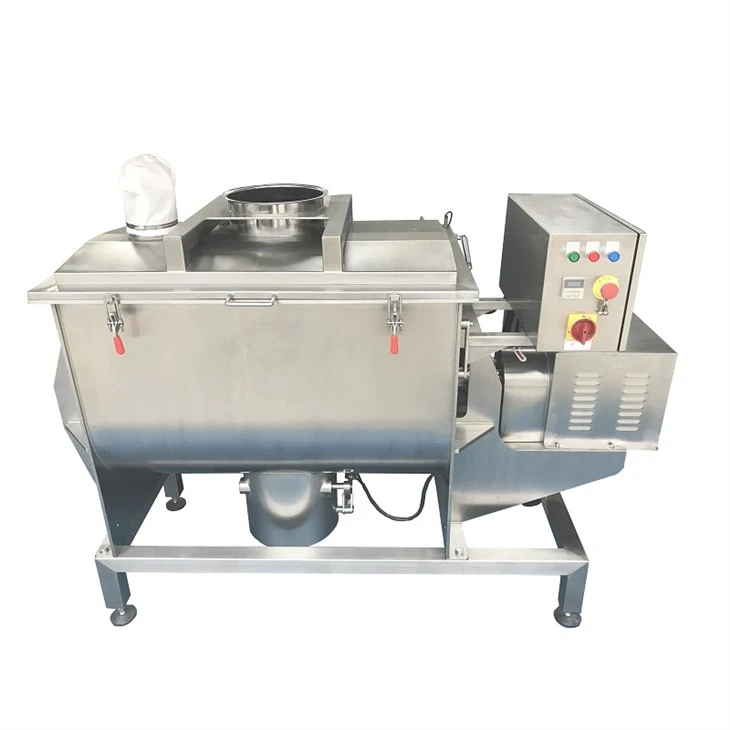
A Helical Mixer uses helical mixing elements to move material through the mixing chamber while producing continuous circulation and redistribution.
The term can refer to different mixer configurations, so the actual mixing mechanism should be evaluated from the equipment design and material movement pattern rather than the name alone.
Helical mixing arrangements may be considered for applications where controlled axial movement and material turnover are required. The suitability depends on powder flowability, bulk density, particle size and the required degree of mixing.
Vertical Mixer
A Vertical Mixer uses a vertically arranged mixing chamber and agitator. Depending on the design, the agitator moves material vertically and radially through the vessel.
Vertical mixers can be useful where floor space is limited or where the production layout favors vertical material handling. They may also be considered for specific powder and granule applications where the material characteristics are compatible with the mixing mechanism.
Available installation space, Batch size, Loading/discharge height, Mixing time, Material flowability, Cleaning requirements, Equipment integration.
Laboratory Mixer for Process Development
A Laboratory Mixer serves a different purpose from a production mixer. It is mainly used for formulation development, material testing and small-batch trials.
Laboratory-scale testing can help determine whether a material can be mixed effectively and provide information for later production-scale equipment selection.
Typical Testing Objectives:- Evaluating powder flowability
- Determining suitable mixing time
- Checking ingredient distribution
- Testing different mixing mechanisms
- Evaluating liquid addition
- Studying material behavior during discharge
For a new powder or formulation, laboratory testing can reduce the risk of selecting production equipment without sufficient information about the material.
Column Lifting Mixer for Flexible Production Layouts
A Column Lifting Mixer incorporates a lifting mechanism that allows a mixing container or related vessel to be raised and positioned at different working heights.
This type of configuration can be considered where the production process requires flexible vessel handling, elevated discharge or connection with downstream processing equipment.
Engineering Evaluation Parameters:The lifting system must be designed according to the actual vessel load and production layout rather than treated as an independent accessory.
How to Select the Right Mixing Equipment
Mixer selection should be based on the material, process and plant conditions.
Material Properties
Before selecting a mixer, the following characteristics directly affect the required mixing mechanism and drive configuration:
Batch Capacity
Mixer capacity should be evaluated using both total vessel volume and actual working volume.
For example, a mixer designed for a 1,000 kg batch cannot be selected simply because its vessel volume appears sufficient. The actual batch weight depends on the material's bulk density and the recommended filling ratio.
Material bulk density + required batch weight + working volume + filling ratio
Mixing Time & Uniformity
Mixing time is not a fixed value for all products. It depends on:
- Material properties & Formulation
- Mixer geometry & Filling level
- Agitator speed & Liquid addition
- Ingredient concentration
For this reason, the required mixing time should preferably be established through testing rather than presented as a universal value.
Product Integrity
Some granules can be damaged by excessive mechanical action. If the product is fragile, the mixer should be evaluated for:
Low-shear mixing may be preferable for materials where particle integrity is important.
Hygienic Construction
For food-grade processing, product-contact components are commonly manufactured from stainless steel such as SUS304 or SUS316L.
• Weld quality
• Shaft seals
• Cleaning access
• Drainability & CIP requirements
Tandy Machinery can configure food-grade mixing equipment around these sanitary design requirements.
Integration with a Complete Powder Processing Line
A mixer normally operates as part of a larger material handling system and needs to be evaluated together with upstream and downstream equipment.
For example, the discharge height must match the downstream conveyor or filling system. The inlet must be compatible with the feeding equipment, while dust extraction may be required around powder loading and discharge points. This approach is particularly important for automated production lines because a mixer with suitable standalone specifications may still create problems if its capacity, discharge position or control system does not match the rest of the line.
Food-Grade Materials and Fabrication
Product-contact components can be manufactured from SUS304 or SUS316L stainless steel according to the application.
Sanitary fabrication standard includes:
- TIG welding
- Full argon shielding
- Precision polishing
- Dimensional inspection
- Food-grade sealing components
The required surface finish should be specified according to the actual cleaning and hygiene requirements of the process. Tandy's current engineering approach includes sanitary fabrication and customized equipment configurations for powder and granule processing.
Applications (Food & Powders)
Mixing equipment can be configured for a range of dry and semi-dry materials, including:
The correct equipment depends on the physical properties of the material and the required production process. For a new project, material samples can be tested for properties such as bulk density, flowability and moisture before the final mixer configuration is determined.
From Mixer Selection to Production Line Engineering
Selecting a mixer is only one part of the engineering process. A complete solution should consider material handling, equipment layout, automation and production requirements from the beginning.
Technical Information Required for a Mixer Quotation
To evaluate a mixing project, buyers should normally provide the following details:
Powder, granule, or powder-granule mixture
Bulk density, Particle size, Moisture content
Required batch weight, production capacity, target mixing time
Required mixing uniformity, liquid addition requirements (if any)
Material temperature, cleaning requirements, electrical power supply
Available space, inlet/discharge heights, existing line equipment
With this information, the mixer can be evaluated according to the actual process rather than selected from capacity alone.
Frequently Asked Questions
What is the difference between a Ribbon Mixer and a Paddle Mixer?
The two mixers use different agitator designs and generate different material movement patterns. Selection depends on the material characteristics, required mixing intensity, product fragility and process requirements.
Can a powder mixer handle granules?
Some mixing configurations can process both powders and granules. Particle size, bulk density, flowability and fragility should be evaluated before selecting the equipment.
Can liquid be added during powder mixing?
Yes, some mixer configurations can incorporate spray bars or nozzles for controlled liquid addition. The liquid quantity, viscosity and required distribution need to be considered during design.
How do I determine the required mixer capacity?
The required capacity should be calculated from batch weight, material bulk density, working volume and the recommended filling ratio.
How long does powder mixing take?
There is no universal mixing time. It depends on the material, formulation, mixer design, filling level and operating conditions. Trial testing is recommended for new materials.
Is SUS316L necessary for food-grade mixing?
Not every food application requires SUS316L. SUS304 is suitable for many food-processing applications, while SUS316L may be selected when higher corrosion resistance or more demanding cleaning conditions are required.
Can a mixer be connected to an automatic packaging line?
Yes. The mixer can be designed with suitable discharge height, discharge valve, conveying interface and control communication for integration with downstream equipment.
Can you test our material before selecting a mixer?
Material testing can be used to evaluate properties such as bulk density, flowability, moisture and mixing behavior. Testing can help determine a more appropriate mixer configuration.
Engineering-Based Mixer Selection
There is no single mixing machine suitable for every powder and granule application. Ribbon Mixer, Paddle Mixer, Helical Mixer, Vertical Mixer, Laboratory Mixer and Column Lifting Mixer represent different equipment configurations and should be evaluated according to the actual material and process.
For Tandy Machinery, the equipment selection process should therefore begin with the customer's material and production requirements, followed by process evaluation, equipment configuration and layout design.