
Integrated Feeding & Mixing System: Installation Requirements, Layout Planning and Key Considerations
In a food processing plant, mixing is only one part of the production process. Before ingredients reach the mixer, they need to be stored, transferred, measured and fed in the correct proportions. When these operations are handled by separate machines without proper coordination, material transfer can become inefficient, production may be interrupted, and operators may spend too much time handling ingredients manually.
An Integrated Feeding & Mixing System brings these operations together into a coordinated production solution. By connecting feeding equipment, conveying units, weighing devices and industrial mixers, manufacturers can create a more organized material handling process, from raw ingredient input to finished mixture discharge.
However, installing an integrated system requires more planning than simply finding enough floor space for a mixer. Equipment dimensions, feeding methods, material characteristics, maintenance access and dust collection arrangements all influence the final layout.
For food manufacturers planning a new production line or upgrading an existing facility, understanding these requirements before purchasing equipment can help avoid unnecessary installation costs and operational problems.
In this guide, we will look at how an integrated feeding and mixing system works, what affects its installation space requirements, and how to plan a suitable layout for your production facility.
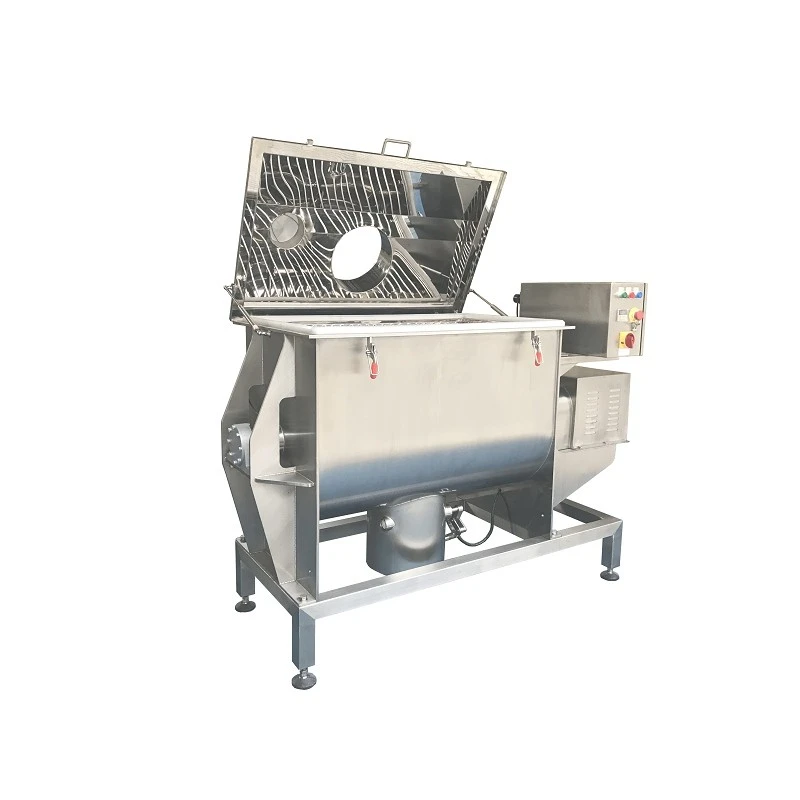
Automated ingredient feeding, batching, and industrial mixing line engineered for hygienic food production.
What Is an Integrated Feeding & Mixing System?
An Integrated Feeding & Mixing System is a coordinated equipment solution that combines raw material feeding, conveying, batching and mixing into one production process.
Instead of manually transferring ingredients between individual machines, the system uses mechanical or automated equipment to move materials from storage or feeding stations to the mixing unit.
A typical configuration may include:
Depending on the production requirements, an integrated system may use screw feeders, vacuum conveyors, pneumatic conveying equipment, ribbon mixers, paddle mixers or other material handling and mixing machines.
For example, in a powdered food production line, flour, sugar and other dry ingredients can be stored in separate hoppers, transferred through feeding equipment, weighed according to a preset formula and delivered into a mixer.
The final configuration depends on the materials being processed, the required production capacity and the level of automation.
What Determines the Installation Space Requirement?
There is no single installation size that applies to every Integrated Feeding & Mixing System. A compact system designed for small-batch production may fit into a relatively limited workshop, while a large automated production line may require additional floor space, structural support and overhead clearance.
Before planning the installation, consider the following factors.
1. Equipment Size and Production Capacity
The overall dimensions of the equipment are the starting point for any layout plan.
A small system may consist of one feeding hopper, a screw conveyor and a compact mixer. A larger system may include multiple storage silos, several independent feeding units, weighing stations, conveyors and a large-capacity industrial mixer.
As production capacity increases, equipment dimensions and material storage requirements generally increase as well.
Do not calculate the required space using only the mixer dimensions. The entire material handling route needs to be included.
2. Raw Material Loading and Feeding Arrangements
The way ingredients enter the system can significantly affect the installation layout.
For manual loading, operators need sufficient space to move ingredient bags, position containers and pour materials into the feeding hopper.
If the system uses automatic feeding, additional space may be required for storage silos, screw feeders, vacuum conveying units or pneumatic pipelines.
For example, a food factory handling flour and starch may use separate storage hoppers connected to screw feeders. Each feeder delivers a controlled amount of material to a weighing station before the ingredients enter the mixer.
In this arrangement, the location of the hoppers, feeding outlets and conveying connections must be planned together.
It is also important to consider how raw materials will reach the feeding area. Forklifts, pallet trucks or bag unloading stations may require additional operating clearance.
3. Mixing and Discharge Configuration
The mixer is usually one of the largest pieces of equipment in the system, but its installation space is also affected by how materials enter and leave it.
A horizontal ribbon mixer, for instance, requires space for the mixing trough, drive motor, gearbox and maintenance access.
The discharge configuration also matters.
A gravity discharge system may need sufficient clearance below the mixer for a collection hopper or container. If the finished material is transferred by a screw conveyor or another conveying unit, additional space must be reserved for that equipment.
For production lines connected directly to packaging machines, the discharge height and material transfer route should be considered during the initial layout design.
4. Maintenance and Inspection Access
An integrated system contains several connected machines, and each component needs to remain accessible for inspection and maintenance.
The maintenance area should provide enough room for technicians to access motors, gearboxes, bearings, feeding screws, valves and electrical components.
The mixer may also require space for opening its cover, inspecting the mixing chamber and removing internal components when necessary.
- Access to motor and gearbox assemblies.
- Space for opening inspection covers.
- Removal and replacement of screw feeders.
- Cleaning access to hoppers and conveying pipes.
- Electrical cabinet access.
- Routes for maintenance tools and replacement parts.
The actual clearance requirements should follow the equipment manufacturer's drawings and the applicable workplace safety regulations.
Avoid placing pipes, walls or other machines too close to equipment access points simply to save floor space.
5. Ventilation and Dust Collection
Powder handling can generate dust during bag unloading, feeding, conveying and mixing.
Materials such as flour, starch, powdered sugar and milk powder may require suitable dust-control arrangements depending on their characteristics and the production environment.
- Dust extraction hoods.
- Dust collection filters.
- Exhaust fans.
- Ventilation ducts.
- Sealed material transfer connections.
Dust collection should be considered as part of the overall system layout rather than added after installation.
For combustible food powders, the dust hazard assessment and appropriate explosion protection measures must also be addressed by qualified engineering personnel in accordance with applicable local requirements.
How to Plan the Installation Space for an Integrated Feeding & Mixing System
Once the main equipment configuration has been determined, the next step is to translate the production requirements into a practical factory layout.
The following planning process can help.
Step 1: Confirm the Complete Equipment List
Start by identifying every machine and auxiliary component included in the system.
Request the manufacturer's equipment drawings and technical specifications before finalizing the installation area.
This is particularly important for customized systems because the dimensions and connection positions may differ from standard configurations.
Step 2: Map the Material Flow
The equipment layout should follow the actual production sequence.
For a typical dry food processing application, the material flow may look like this:
Ideally, materials should move through the system without unnecessary backtracking or repeated manual handling.
For example, placing the feeding and weighing units close to the mixer can help shorten transfer routes. Positioning the discharge equipment near the next processing stage can also reduce additional conveying requirements.
The layout should reflect the physical behavior of the ingredients as well as the production sequence.
Step 3: Calculate the Equipment Footprint and Clearance
Obtain the length, width and height of each machine.
Then identify the additional clearance required for:
- Operator access.
- Raw material loading.
- Product discharge.
- Equipment inspection.
- Component replacement.
- Cleaning and maintenance.
There is no universal rule that every machine needs the same clearance on all sides. The required distance depends on its structure, access points and maintenance procedures.
For this reason, it is better to work from the manufacturer's general arrangement drawings instead of applying one fixed clearance measurement to the entire system.
Step 4: Check Building Height and Structural Conditions
Floor space is only one part of the installation requirement.
An integrated feeding and mixing system may include elevated hoppers, storage tanks, vertical conveyors and overhead pipelines.
Before installation, check:
- Available ceiling height.
- Floor loading capacity.
- Equipment foundation requirements.
- Structural support for elevated components.
- Access for lifting and positioning large machines.
- Electrical power and compressed air connections.
For large-capacity systems, the building structure and equipment foundation should be reviewed by qualified engineering professionals.
Step 5: Plan Utilities and Supporting Systems
The system may require electrical power, compressed air, ventilation, dust collection and other utility connections.
These connections should be included in the layout from the beginning.
Control cabinets should be placed in accessible locations, while cables and pipelines should be arranged to avoid interfering with material movement or routine maintenance.
If the system will be integrated with an existing production line, the connection points and communication requirements of the upstream and downstream equipment should also be confirmed.
Why Choose an Integrated Feeding & Mixing System Instead of Separate Machines?
Some food factories purchase feeding machines and mixers separately, connecting them through manual operations or simple conveyors.
This arrangement can work for certain production environments. However, as production volume increases, coordinating separate machines may become more difficult.
An integrated solution offers several practical advantages.
Better Coordination Between Feeding and Mixing
In a conventional production setup, operators may need to monitor material feeding and mixer operation independently.
An integrated system allows the feeding equipment and mixer to operate according to a coordinated production sequence.
For example, a screw feeder can deliver ingredients to a weighing unit, which then supplies the mixer according to the required batch quantity.
This helps reduce unnecessary waiting between processing stages.
Reduced Manual Material Handling
Moving ingredients manually between machines takes time and requires additional labor.
An integrated system can automate or simplify these transfer operations.
For factories handling large quantities of flour, starch, sugar or other dry ingredients, this can make the production process more organized and reduce repetitive manual handling.
More Consistent Batching and Mixing
The quality of a finished mixture depends partly on whether the correct ingredients are supplied in the correct proportions.
When feeding and weighing equipment are properly configured, an integrated system can support more consistent ingredient measurement and batch preparation.
The actual accuracy depends on the weighing devices, material characteristics, control system and operating conditions.
More Efficient Factory Layout
Combining equipment into a coordinated production line can reduce unnecessary transfer points and improve the use of available floor space.
Rather than positioning individual machines wherever space is available, manufacturers can plan the equipment according to a continuous material flow.
This can also make future production expansion easier to evaluate.
Which Industries Can Use an Integrated Feeding & Mixing System?
Integrated feeding and mixing solutions are used in different industries that process powders, granules and other bulk materials.
For food processing manufacturers, common applications include the following.

The equipment configuration should always be selected according to the actual material properties and production requirements.
Flour and Bakery Ingredient Processing
Flour, starch, sugar and other dry ingredients can be fed into a batching system and mixed according to production formulas.
Powdered Beverage Production
Ingredients such as milk powder, cocoa powder, sugar and other powdered components can be transferred and mixed through a coordinated feeding system.
Seasoning and Spice Manufacturing
Multiple powdered ingredients can be weighed and supplied to a ribbon mixer or another suitable blending machine to produce seasoning mixtures.
Nutritional Food Production
Protein powders, nutritional ingredients and other dry materials may require controlled feeding and batching before blending.
Dairy and Milk Powder Processing
Milk powder and other powdered dairy ingredients can be transferred between storage, feeding and mixing equipment.
Snack Food Manufacturing
Dry ingredients and granular materials can be supplied to mixers and other processing equipment as part of a larger production line.
How to Choose the Right Integrated Feeding & Mixing System
Choosing a system based only on its mixing capacity is not enough. The feeding section, conveying arrangement and control system all influence the overall performance.
Before requesting a quotation, consider these important factors.
Production Capacity
Determine how much material needs to be processed per hour or per batch.
A system designed for small-batch production may have a different configuration from one intended for continuous, high-volume manufacturing.
Material Characteristics
Provide information about the materials, including:
- Material names and applications.
- Particle size and bulk density.
- Moisture content.
- Flowability.
- Whether the material is sticky, abrasive or prone to dust generation.
These details help the manufacturer select appropriate feeding and mixing equipment.
Mixing Requirements
Different products require different mixing methods.
A ribbon mixer may be suitable for many dry powder and granule applications, while other materials may require a paddle mixer or a different mixing configuration.
The choice should be based on the ingredients, desired mixing result and production process.
Automation Level
Some factories only need mechanical feeding and basic mixer controls.
Others may require automatic weighing, recipe management, feeding sequence control and integration with packaging equipment.
The right automation level depends on production volume, labor arrangements and the complexity of the manufacturing process.
Cleaning and Hygiene
For food applications, the equipment should be designed with appropriate material contact surfaces and cleaning access.
SUS304 stainless steel is commonly used for food processing machinery, while SUS316L may be considered for more demanding corrosion conditions.
The final material selection should depend on the ingredients, cleaning chemicals and operating environment.
Why Source an Integrated Feeding & Mixing System from China?
China has a broad manufacturing base for food processing machinery, powder handling equipment and industrial mixing systems.
For international buyers, working with experienced China Integrated Feeding & Mixing System manufacturers can provide access to different equipment configurations and customized production line solutions.
However, choosing the right manufacturer involves more than comparing quotations.
Here are several points worth checking before placing an order.
Equipment Manufacturing Capabilities
Check whether the manufacturer produces feeding equipment and mixing machines in-house or coordinates the system through multiple suppliers.
A company with relevant manufacturing and engineering experience may be better positioned to coordinate equipment dimensions and connection requirements.
System Integration Experience
An Integrated Feeding & Mixing System requires different machines to work together.
Ask whether the manufacturer has experience connecting screw feeders, weighing systems, conveyors and industrial mixers into a complete production process.
Customization Capabilities
Every food factory has different raw materials, production capacity and building conditions.
A qualified China Integrated Feeding & Mixing System factory should be able to evaluate your requirements and recommend suitable equipment configurations.
Technical Documentation
Request equipment drawings, technical specifications, electrical requirements and installation information before confirming the order.
These documents are particularly important when the equipment will be installed in an existing factory.
After-Sales Support
Confirm whether the supplier can provide installation guidance, commissioning support, operating instructions and spare parts.
These services can make a significant difference when purchasing machinery from overseas.
Customized Integrated Feeding & Mixing System Solutions
A standard equipment configuration may not fit every production facility.
For factories with limited installation space, unusual material characteristics or specific production requirements, a Customized Integrated Feeding & Mixing System can offer a more suitable solution.
Customization may involve:
- ✓ Different numbers and capacities of feeding hoppers.
- ✓ Customized screw feeder dimensions.
- ✓ Automatic or semi-automatic weighing systems.
- ✓ Horizontal or vertical conveying arrangements.
- ✓ Different mixer types and capacities.
- ✓ SUS304 or SUS316L stainless steel construction.
- ✓ Customized discharge heights and connection positions.
- ✓ Integrated dust collection systems.
- ✓ Centralized electrical control and automation.
For example, a food manufacturer producing several powdered seasoning products may require multiple ingredient feeding stations connected to one mixing unit.
Another factory handling large volumes of flour may need storage silos, automatic screw feeding, weighing equipment and a high-capacity mixer.
In both cases, the system should be designed around the actual production process rather than forcing the factory to adapt to an unsuitable standard machine.
Looking for an Integrated Feeding & Mixing System for Sale?
Whether you are building a new food processing facility or upgrading an existing production line, choosing the right equipment configuration is an important investment decision.
If you are comparing an Integrated Feeding & Mixing System for sale, look beyond the individual machine specifications. Consider the complete material flow, feeding accuracy, mixing capacity, installation dimensions and future maintenance requirements.
As a food processing machinery manufacturer, we provide equipment solutions for powder and granule handling, feeding and industrial mixing applications.
If you are interested in wholesale Integrated Feeding & Mixing System purchasing or need a complete customized solution, our team can help evaluate your production requirements.
- Type of raw materials to be processed.
- Required production capacity.
- Number of ingredients.
- Desired mixing method.
- Available installation space.
- Required automation level.
Looking for reliable China Integrated Feeding & Mixing System manufacturers or suppliers?
Contact our team to discuss your project, review the equipment layout and request a customized quotation.


